Introduction
This
article examines the comparison between IGCSE and GCSE qualifications,
specifically focusing on the minimum expected grades at the 75th percentile,
and some factors to consider when interpreting the
value-added for IGCSE qualifications in Connect and Summit.
This
analysis is drawn from the matched KS2 to IGCSE/GCSE from the DfE national
dataset from 2024 outcomes. The IGCSE sample represents only those students
from schools participating in Year 6 SATs testing, which is not representative
of the broader IGCSE cohort in the UK.
Connect
and Summit currently use GCSE benchmarks for value-added analysis from IGCSE
outcomes.
Throughout the article, we critically analyse the data available for the IGCSE suite of qualifications and infer the impact this may have on the value-added analysis in Connect and Summit which is based on mapping the IGCSEs to GCSE qualifications.
You will see that the IGCSE sample size is relatively small, and therefore the impact any of the numbers will have on your analysis is questionable.
As a principle, Alps analysis is designed to allow school and college leaders to assess the relative strengths and weaknesses of the progress being make by students and groups of students across the curriculum. The IGCSE analysis is an integral part to many school curricula and as such it is an important inclusion in the value-added picture. Connect gives leaders a tool from which to begin conversations with school staff about value-added outcomes, be that for GCSE or IGCSE qualifications.
The Challenge of
Comparative Analysis
When
attempting to benchmark IGCSE outcomes using value-added methodologies designed
for GCSE qualifications, there is one overriding limitation: the requirement
for a matched dataset that links final examination outcomes with Key Stage 2
prior attainment data.
The majority
of IGCSE qualifications in the UK are taken by students in schools which do not
participate in Year 6 SATs. This creates a substantial reduction in the
available matched dataset, raising important questions about the
representativeness and reliability of any subsequent analysis.
Sample Size: A Critical
Limiting Factor
Table 1 shows that the 2023/24 IGCSE dataset contains just 500
matched entries across all prior attainment bands, compared with 542,336
entries in the GCSE dataset.
Table
1: Sample Distribution
|
|
DfE national 2024 IGCSE
|
|
DfE national 2024 GCSE
|
|
Alps Band
|
KS2 Range
|
Included Entries
|
% In Band
|
Included Entries
|
% In Band
|
|
1
|
117.00 - 120.00
|
69
|
14%
|
11052
|
2%
|
|
2
|
113.50 - 116.50
|
103
|
21%
|
39153
|
7%
|
|
3
|
110.00 - 113.00
|
88
|
18%
|
81828
|
15%
|
|
4
|
107.50 - 109.50
|
44
|
9%
|
79247
|
15%
|
|
5
|
105.00 - 107.00
|
49
|
10%
|
87477
|
16%
|
|
6
|
102.50 - 104.50
|
37
|
7%
|
78503
|
14%
|
|
7
|
100.00 - 102.00
|
16
|
3%
|
56868
|
10%
|
|
8
|
96.00 - 99.50
|
30
|
6%
|
54131
|
10%
|
|
9
|
90.00 - 95.50
|
29
|
6%
|
35958
|
7%
|
|
10
|
71.00 - 89.50
|
35
|
7%
|
18119
|
3%
|
|
|
Total
|
500
|
|
542,336
|
|
This reduction in sample size introduces several considerations:
1.
Statistical Reliability:
With fewer than 20 students in some prior attainment bands, the inference of impact that any of this might have on IGCSE outcomes becomes questionable.
2.
Unknown Subset Characteristics:
We cannot determine with certainty what subset of schools
and students this sample represents, e.g. are these selective or non-selective
institutions?
3.
Representativeness:
The sample may not be representative of the broader IGCSE cohort, particularly
given the selection bias inherent in which schools have matched KS2 data
available.
Distribution Across Prior
Attainment Bands
There are
significant differences in student distribution across prior attainment bands
between IGCSE and GCSE cohorts. The IGCSE sample shows a marked concentration
in higher prior attainment bands (1-3), with 53% of students in these bands
compared to just 14% in the GCSE dataset.
This
skewed distribution towards higher prior attainment suggests that the IGCSE
sample, despite its limitations, may predominantly represent students with
stronger academic profiles. However, we must again exercise caution: this could
be an artefact of the sampling methodology rather than a true reflection of the
IGCSE cohort nationally.
Comparison of Minimum
Expected Points at the 75th Percentile
Table 2
shows the Minimum Expected Points (MEPs) at the 75th percentile for
the IGCSE and GCSE qualifications.
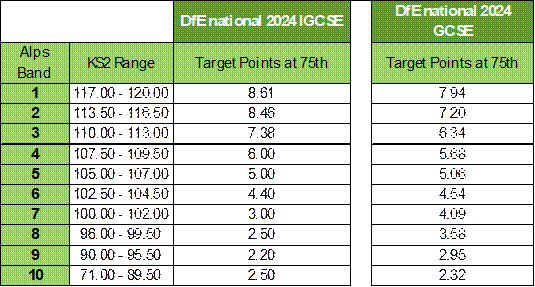
Higher
Bands (1-4): IGCSE
shows marginally higher target points across bands containing the majority of
IGCSE students:
Middle
to Lower Bands (5-10): The pattern becomes less consistent:
Implications for
Value-Added Analysis
These
differences will have implications on value-added analysis depending on the
distribution of students within a particular cohort:
For
cohorts concentrated in Bands 1-4:
Using GCSE-based benchmarks may produce a redder
value-added picture than would be appropriate for IGCSE qualifications. The
higher minimum expected points for IGCSE in these bands suggest that students
are generally performing above what would be expected in the GCSE framework.
For
cohorts concentrated in Bands 7-8:
The reverse effect occurs, where GCSE benchmarks might
present a ‘bluer’ value-added picture than may be showing in Connect.
However,
given the significant sample size limitations, particularly in the lower bands
where some contain fewer than 30-40 students, we must question whether these
differences represent genuine patterns or statistical artifacts.
Recommendations and
Conclusions
When
interpreting value-added analyses for IGCSE qualifications, education leaders
should:
1.
Acknowledge the Limitations:
Explicitly recognise that the small matched sample size
(500 vs 542,336) fundamentally limits the reliability of any comparative
analysis.
2. Understand your prior attainment distribution
We would suggest that education leaders could look at the distribution of prior attainment for any students who are taking International GCSE qualifications to understand how their own distribution of learners might affect the analysis from Connect or Summit.
3.
Exercise Interpretative Caution:
Use the information in this article in the spirit intended. There appear to be differences in MEPs between IGCSE and GCSE, however we cannot fully understand the impact these may have on IGCSE analysis. As Alps is designed as a tool from which to begin conversations around school improvement, then we believe the relative analysis of your value-added outcomes across your curriculum within Connect remains a valid and worthwhile exercise when developing priorities.